
The advent of artificial intelligence has revolutionized every aspect of content creation. Just a few short years ago, these tools were merely correcting grammatical errors and offering word substitutions to improve written documents.
Today, we utilize AI to compose complete blog entries, sell pages, newsletters, and scripts, while producing product descriptions, captions for social media, and even detailed business reports.
The speed at which you can create content has increased significantly; creating blog posts or not having to staff many writers if you are in business has also become an easy way to produce much more work than ever before.
Organizations and professionals utilize AI writing assistants for many reasons. For example, as a blogger, you may be looking for ways to decrease the amount of time spent putting together research, or as a company with multiple marketing clients, you can utilize AI tools to write multiple projects quickly and cost-effectively.
Despite the convenience of using AI software to help create content, an issue that remains is finding the best tool that fits your particular needs. Many hundreds of writing software programs exist on the market today, and many often produce repetitive text, robotic language, or are fast in producing a completed piece, but cannot help your page gain rank on Google. You need to ensure that you select the appropriate AI software to serve your needs.
Why AI Writing Tools Matter in 2026?
With the mass quantities of content being produced each day, content marketing has become highly competitive. The internet is flooded with thousands of new posts and articles every day, which have to meet a certain standard of quality in order to be indexed properly by search engines; otherwise, they will not receive adequate traffic.
Creating new articles manually can hinder growth due to the time it takes to complete that task.
With the introduction of AI-assisted writing tools, businesses can now:
- Increase productivity (creating content faster)
- Create new ideas for articles
- Create clear outlines for articles
- Repurpose previous content for use in other media
- Write SEO-focused drafts
- Improve the readability of their work
- Expand their marketing efforts
The key to achieving the best results is to work together by having humans write slowly and have AI produce articles quickly, thus allowing humans to concentrate on developing strategy and emotional depth while machines handle speed.
How We Evaluated the Best AI Writing Tools?
We used practical criteria that actually matter to publishers and agencies.
Writing Quality
To qualify as a competent AI writer, the writer’s written material should be very relatable. When evaluating AI writer quality, we considered the following:
- Flow and clarity of written sentences
- The difference between writing like a human versus a machine.
- Understanding of the context of your writing
- Long-form consistency.
SEO Performance
Achieving a decent ranking in Google requires considerable optimization. We checked:
- The creation of headings in the proper format.
- How well keywords have been integrated into the written sentence.
- The accuracy of the use of each word used in every sentence.
- The existence of an effective workflow system in place for use regarding the search engine optimization of your site.
Ease of Use
Even if you want to use a tool, it will not benefit you if the tool is challenging to navigate. Therefore, we reviewed the user dashboards to evaluate speed and ease of use.
Pricing & Value
Monthly costs were compared to the quality of results, and a high cost was deemed acceptable only if significant amounts of time would be saved.
ChatGPT

You can use ChatGPT to get assistance with multiple tasks. However, it’s not just a static tool but rather an interactive partner when completing any of these requests:
You can ask it to:
- Rewrite specific sections
- Expand on your ideas
- Change the tone of a piece
- Simplify technical topics
Where ChatGPT Performs Best
For blogs, ChatGPT excels at creating long, detailed, structured articles that are easy to read. You will get clearly defined sections arranged in a logical manner with easy-to-follow transitions. It can also be very helpful when used to brainstorm new ideas and turn one written piece into multiple social media or email campaign posts.
Strengths
- Extremely flexible for any task
- Strong reasoning abilities
- Supports many different writing styles
Weaknesses
- Requires very good prompting skills
- No built-in SEO scoring system
Jasper AI

Jasper AI’s main service is to automate the marketing process through the use of artificial intelligence. The target users include all types of businesses that generate a high volume of content each month.
Key Features
Jasper is capable of remembering the unique style and messaging characteristics of your brand. Additionally, there are numerous pre-built templates available for Google Ads, Facebook Ads, and landing pages within the platform.
Strengths
- Strong focus on marketing tasks
- Consistent brand messaging
- Excellent for team collaboration
Weaknesses
- Expensive monthly pricing
- Less flexible than ChatGPT
Claude AI
Claude AI is sought after by many authors since Claude creates texts that feel coherent and intelligent, with greater variety in terms of sentence types and fewer mechanical phrases or redundant information being found within each document.
Best Use Cases
Claude works particularly well in producing quality material related to industry trends or ongoing strategy development. In addition, Claude continues delivering consistent output over the course of multiple long-form documents due to its high-quality writing style compared to similar programs.
Strengths
- Very natural writing tone
- Excellent handling of long documents
- Strong logical structure
Weaknesses
- Fewer marketing templates
- Limited SEO features
Writesonic
Writesonic is a content generation system that also incorporates search engine optimization (SEO) in order to assist you in ranking higher on Google.
Important Features
In Writesonic, you can see your keyword suggestions and SERP insights right within the tool, and you create structured drafts to publish much quicker than you would have otherwise.
Strengths
- SEO-focused workflow
- Affordable pricing plans
- Great for affiliate blogs
Weaknesses
- Content can feel a bit templated
- Creativity is sometimes limited
Copy.ai
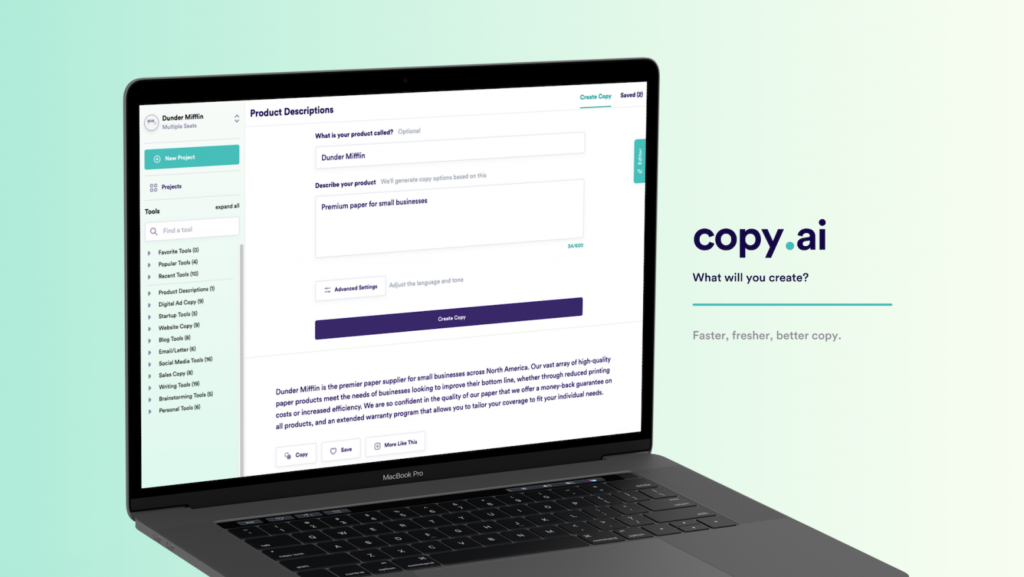
Copy.ai specializes in short-form content. You should use this when you need quick results for ads or social media.
Strengths
- Beginner-friendly interface
- Large library of templates
- Fast generation for quick campaigns
Weaknesses
- Not ideal for long-form articles
- Limited research capabilities
Grammarly AI
Bringing AI to write better grammatically, the only AI tool of its kind to develop existing work as well as create new work.
Core Benefits
It improves your grammar accuracy and tone consistency. You can use it to ensure your business communication remains professional and clear.
Strengths
- Works across all browsers and apps
- Excellent at fixing mistakes
- Helps refine your professional tone
Weaknesses
- Limited in generating new content
- Not built for SEO workflows
AI Writing Tools Comparison Table
| Tool | Best For | Main Strength | Main Weakness |
| ChatGPT | Overall versatility | Flexibility | No SEO scoring |
| Jasper AI | Marketing teams | Brand consistency | Expensive |
| Claude | Natural writing | Human-like tone | Fewer templates |
| Writesonic | SEO content | Search focus | Needs editing |
| Copy.ai | Short marketing copy | Fast results | Weak long-form |
| Grammarly | Editing & polish | Accuracy | Not a generator |
Which AI Writing Tool Should You Choose?
Your selection will depend entirely on your unique workflow:
- Select ChatGPT if you want more flexibility and advanced research support.
- Select Jasper AI if you want to collaborate in teams and maintain consistent branding.
- Select Claude if you wish to write with a conversational tone that feels very human.
- Select Writesonic if your goal is primarily to drive traffic from search engines.
- Selecting Copy.ai will help you create lots of short-form marketing materials quickly.
- Grammarly can be used to proofread your writing before it is published.
The Biggest Mistake People Make With AI Writing
While it may seem convenient to employ an AI writing tool for creating flawless content quickly, this mindset leads to poor performance because there is still human involvement through editing and fact-checking.
Additionally, Google rewards those who demonstrate expertise and credibility. Therefore, articles that lack substance generated solely by AI will not have consistent performance.
Final Verdict
AI writing serves as a vital component of today’s digital landscape; selecting the appropriate platform can greatly increase your publishing speed as well as the scalability of content creation. ChatGPT is likely the best all-around choice, but Jasper is best suited for marketers, and Claude excels at producing quality written materials. Since no one application works well for every person, selecting a writing tool that aligns with your objectives will allow you to capitalize on how AI can impact your future work.

Pingback: 10 Powerful AI Video Generators 2026: Create Viral Content Fast
Pingback: Canva Pro Review 2026: Shocking Truth About AI Magic Studio
Pingback: 7 Massive Ways Generative AI is Transforming SaaS in 2026