In 2026, marketing is no longer about manual campaigns and guesswork. It is about marketing automation, AI-powered marketing tools, and real-time personalization at scale.
Businesses that automate intelligently are outperforming competitors in lead generation, customer retention, and revenue growth. And businesses that do not automate intelligently are drowning in manual tasks.
If you want to stay competitive, these are the must-have marketing automation tools that define modern growth systems in 2026.
Why Marketing Automation Is No Longer Optional
Marketing automation allows businesses to:
- Automatically nurture leads
- Trigger personalized email sequences
- Track customer journeys
- Score prospects based on behavior
- Integrate sales and marketing pipelines
- Increase conversion rates
The global shift toward AI marketing automation has made it easier than ever to scale campaigns without scaling headcount.
If you want to stay competitive, these are the must-have marketing automation tools that define modern growth systems in 2026.
Now let’s break down the top 7 tools that businesses can’t ignore in 2026.
1. HubSpot – All-in-One Marketing & CRM Automation
If there is one platform that defines modern CRM software and marketing automation, it’s HubSpot.
Why It’s Essential:
- Advanced email marketing automation
- Lead scoring and segmentation
- Marketing analytics dashboards
- Workflow automation builder
- Integrated sales pipeline management
- AI-powered content optimization
HubSpot connects marketing, sales, and service teams in one ecosystem and eliminates silos. It is best for growing businesses that need a unified platform.
2. ActiveCampaign – Advanced Email & Customer Journey Automation
ActiveCampaign stands out for its sophisticated automation engine.
Key Features:
- Behavioral tracking
- Conditional email sequences
- Dynamic content personalization
- CRM integration
- SMS marketing automation
Its automation workflows allow businesses to create hyper-personalized experiences based on user behavior. It is best for businesses focused heavily on email marketing and lifecycle automation.
3. Mailchimp – Beginner-Friendly Automation for SMBs
Mailchimp has evolved far beyond newsletters.
What Makes It Powerful in 2026:
- AI-powered subject line optimization
- Customer segmentation
- Automated welcome sequences
- Predictive audience insights
- E-commerce integration
For small and mid-sized businesses, it offers a simple entry into automated email marketing without overwhelming complexity. Startups and small businesses should transition from manual email campaigns.
4. Marketo – Enterprise-Grade Automation
Marketo (by Adobe) dominates in enterprise environments.
Why Enterprises Choose It:
- Advanced lead scoring
- Account-based marketing (ABM)
- Cross-channel campaign orchestration
- Deep analytics and attribution modeling
- Integration with the Adobe ecosystem
It’s built for complex buyer journeys and large sales teams. It is best for large B2B organizations that require advanced automation and scalability.
5. Klaviyo – E-commerce Marketing Automation Leader
In e-commerce, timing is everything. Klaviyo excels at revenue-driven automation.
Core Strengths:
- Abandoned cart recovery automation
- Post-purchase email flows
- Predictive analytics
- Customer lifetime value tracking
- SMS and email integration
Klaviyo directly ties automation to revenue metrics and is best for E-commerce brands that are scaling aggressively.
6. Salesforce Marketing Cloud – Omnichannel Marketing Automation
Salesforce Marketing Cloud enables true omnichannel automation.
What It Delivers:
- Email automation
- Social media automation
- SMS marketing
- Mobile push notifications
- AI-powered predictive analytics
- Customer data unification
Its strength lies in handling large datasets across multiple channels. It is best for enterprises running multi-channel global campaigns.
7. Zapier – Workflow Automation Connecto
Not every automation needs a full marketing suite. Zapier connects thousands of apps without coding.
Why It’s Indispensable:
- Automates repetitive workflows
- Connects CRM, email, social media, and project tools
- Triggers actions across platforms
- Saves hours of manual data entry
Even advanced marketing stacks rely on Zapier to connect tools seamlessly. It is best for businesses that are building customized automation systems.
How to Choose the Right Marketing Automation Tool
Before choosing a platform, ask:
- Are you B2B or B2C?
- Do you need CRM integration?
- Is email your primary channel?
- Do you require enterprise-level analytics?
- What is your monthly marketing budget?
Don’t choose the most powerful tool; choose the one aligned with your strategy.
Key Benefits of Marketing Automation in 2026
1. Higher Conversion Rates
Automated lead nurturing increases conversion probability significantly.
2. Improved Customer Retention
Lifecycle marketing keeps customers engaged.
3. Data-Driven Decision Making
Advanced analytics enable smarter optimization.
4. Scalability Without Hiring
Automation replaces repetitive manual tasks.
5. Personalized Customer Experience
AI-powered personalization drives engagement.
Marketing automation is about empowering them.
Common Mistakes to Avoid
Even with the best tools, businesses often fail because they:
- Ignore analytics
- Fail to segment audiences
- Skip A/B testing
- Don’t align marketing with sales
Automation amplifies strategy, whether it is good or bad, and then builds a solid strategy.
The Future of Marketing Automation
In 2026 and beyond, expect:
- AI-generated campaign optimization
- Predictive customer behavior modeling
- Real-time personalization engines
- Advanced conversational AI
- Deeper CRM automation integration
The businesses that win will be those that automate intelligently, not blindly.
Final Thoughts
Marketing in 2026 demands speed, personalization, and scalability.
The right marketing automation software can:
- Increase revenue
- Reduce manual work
- Improve customer experience
- Deliver measurable ROI
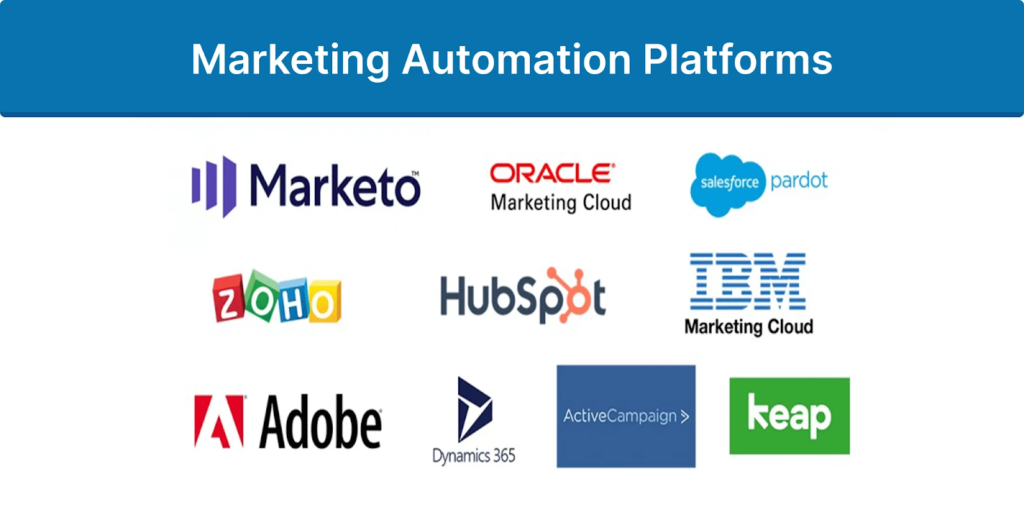
Whether you choose HubSpot CRM, ActiveCampaign, Mailchimp, Marketo, Klaviyo, Salesforce Marketing Cloud, or Zapier, the goal remains the same:
Build systems that scale because Automation is not optional anymore.
It is the infrastructure of modern growth.
FAQs
1. What is marketing automation?
Marketing automation refers to software that automates marketing tasks such as email campaigns, lead nurturing, customer segmentation, and performance tracking.
2. Which marketing automation tool is best in 2026?
The best tool depends on your business size and goals:
- SMBs: Mailchimp or ActiveCampaign
- Growing businesses: HubSpot
- Enterprise: Marketo or Salesforce Marketing Cloud
- E-commerce: Klaviyo
3. Is marketing automation worth it for small businesses?
Yes. Even small businesses benefit from automated email marketing, customer segmentation, and workflow automation.
4. How much does marketing automation software cost?
Pricing varies:
- Entry-level plans: $20–$50/month
- Mid-tier: $100–$800/month
- Enterprise: Custom pricing
ROI depends on usage and implementation.
5. Can marketing automation increase sales?
Yes. Properly implemented lead nurturing automation improves engagement and increases conversion rates significantly.
6. What is the difference between CRM and marketing automation?
CRM software manages customer relationships and sales pipelines.
Marketing automation software handles campaign execution, lead nurturing, and audience engagement.
Many modern platforms combine both.
Marketing automation is no longer a luxury.
It’s your competitive edge in 2026.